

.svg)


.png)
The Nigerian with some earning power, who is slightly above the poverty line, has been scared to save their money in Naira in the last five(5) years. With Nigeria's inflation rate consistently among the highest in Africa, finding a savings account that actually grows your money rather than quietly eroding it is more important than ever.
This guide breaks down the best high-yield savings accounts available to Nigerians in 2026, covering everything from traditional bank options to fintech platforms offering competitive interest rates.
Why high-yield savings accounts matter in Nigeria
Nigeria's inflation rate has hovered well above 20% in recent years, meaning a standard savings account paying 4–6% per annum is effectively losing you purchasing power every month. High-yield savings accounts and money market instruments can help close that gap, though it's important to set realistic expectations. Very few naira-denominated accounts will fully beat inflation, but the right choice can significantly slow the erosion of your savings.
Beyond inflation, Nigerians also face challenges like:
- Currency depreciation of the naira against the dollar
- CBN policy changes that affect interest rates overnight
- Limited access to dollar-denominated accounts for everyday savers
- Trust concerns with newer fintech platforms
What to look for in a high-yield savings account
Before jumping into specific recommendations, here are the key factors to evaluate:
Interest Rate (APY): This is the headline number, but always check if it's fixed or variable, and whether promotional rates expire after a few months.
Minimum Balance: Some accounts offer high rates only if you maintain a minimum balance, sometimes as high as ₦500,000.
Liquidity: Can you access your money anytime, or is it locked in for a fixed term? Fixed deposits typically pay more but restrict withdrawals.
Deposit Insurance: Is your money covered by the Nigeria Deposit Insurance Corporation (NDIC)?
Platform reputation and regulation: Is the institution licensed by the Central Bank of Nigeria (CBN)? Fintech platforms should be checked against the CBN's list of licensed institutions.
Best High-Yield Savings Options for Nigerians
1. Piggyvest
Best for: Disciplined savers who want to lock away money
PiggyVest is one of Nigeria's most popular savings and investment platforms, with millions of users. It offers several savings products:
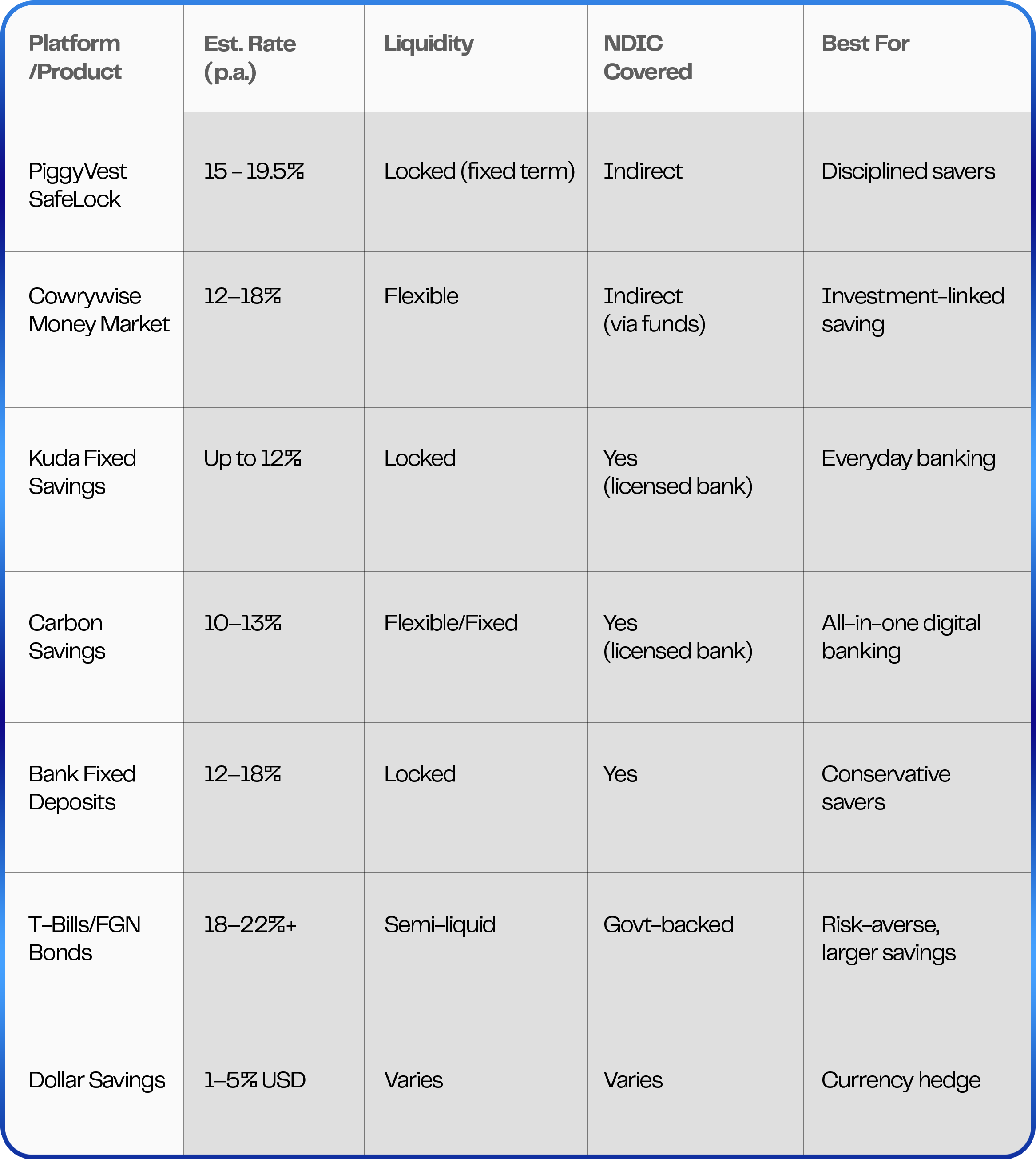
- SafeLock: Lock your funds for a period you choose (10–1000 days) and earn up to 15 - 19.5% per annum. You cannot withdraw before your set withdrawal date, which is great for self-discipline.
- Flex Dollar: Save in US dollars and earn interest in USD, helping you hedge against naira depreciation.
- PiggyBank: A regular savings plan where you automate savings daily, weekly, or monthly. 16% per annum
- House Money: House money is a savings option for people who are saving towards their rent. So while you save towards your next rent, you can earn 15% interest per annum on that money.
- Target Savings: You can create a private or group target savings if you’re saving towards something else that’s not your rent, and earn 14% interest per annum on it.
- Flex Naira: Flex Naira, as the name implies, is one of the more flexible savings options Piggyvest offers. You can make as many withdrawals as you want per month (although not advised) and earn up to 12% interest per annum.
PiggyVest invests your funds in money market instruments and works with licensed financial institutions. It is not a bank itself, so funds are not directly NDIC-insured; always review their terms on how funds are held.
Typical Rate: 15 - 19.5% per annum. on naira SafeLock (rates vary and are updated periodically)
2. Cowrywise
Best for: Savers who also want investment exposure
Cowrywise is a SEC-registered investment platform that blends savings with money market fund investments. Key offerings include:
- Stash: A flexible savings plan with competitive interest rates
- Circle: Group savings with friends or colleagues
- Money Duo:
- Halal savings: An interest free savings option suitable for muslims.
- Money Market Funds: Access to Stanbic IBTC Money Market Fund, ARM Money Market Fund, and others, typically yielding 12–18% p.a., depending on market conditions
Because Cowrywise channels money into regulated mutual funds, your returns move with the broader money market, which tends to track the CBN's Monetary Policy Rate (MPR). When the MPR is high, these funds perform well.
3. Kuda Bank
Best for: Everyday banking combined with decent savings rates
Kuda is a CBN-licensed digital microfinance bank, meaning your deposits are covered by NDIC. Kuda offers:
- A Spend+Save feature that rounds up transactions and saves the difference automatically
- A Fixed Savings option where you lock funds and earn a higher interest rate
- Competitive rates compared to traditional banks, though generally lower than pure fintech savings platforms
Kuda's strength is convenience, it's a full bank, so you can receive salary, spend, and save all in one place. The trade-off is that interest rates may be slightly lower than those of non-bank platforms.
Typical Rate: Up to 12% p.a. on fixed savings.
4. Carbon
Best for: Users who want savings plus easy access to credit
Carbon is a CBN-licensed digital bank offering a Carbon Savings product. It pays competitive interest on deposits and allows you to earn more by keeping funds in the account longer. Carbon also has a strong track record in Nigeria's fintech space and a transparent fee structure.
Saving with Carbon also lets you earn up to 20% interest on your savings with a 12-month fixed Cash Vault plan.
5. Traditional bank fixed seposits
Best for: Conservative savers who prioritize security and NDIC coverage
Nigeria's major commercial banks, including Zenith Bank, GTBank (Guaranty Trust), Access Bank, First Bank, and UBA, all offer fixed deposit accounts with rates often higher than those of standard savings accounts. As of 2024–2025, fixed deposit rates from top-tier banks typically ranged from 12–18% p.a., depending on tenor and amount.
Key advantages:
- Full NDIC deposit insurance (up to ₦5 million)
- Strong regulatory oversight
- Physical branches for in-person support
The downside is that funds are locked for the chosen period (30, 60, 90, 180, or 360 days), and early withdrawal often incurs penalties.
Recommended banks: Zenith Bank, GTBank, Stanbic IBTC Bank (especially for money market-linked products)
6. Dollar/USD savings accounts
Best for: Protecting savings from naira devaluation
Given the history of naira depreciation, many financially savvy Nigerians keep a portion of their savings in USD. Options include:
- PiggyVest Flex Dollar — save in USD and earn dollar-denominated interest (~ 6% p.a. in USD)
- Pesa — Although your Pesa wallet doesn't directly serve as a savings account, you can hold your USD or other currencies in it as a way to hedge against inflation.
- Domiciliary Accounts at commercial banks — interest rates are low (often under 1% p.a.), but you benefit from any naira-USD exchange rate movement
Dollar savings are not a "high yield" play in the traditional sense, but they serve as a hedge. Even at 1–3% USD interest, if the naira loses 20% of its value against the dollar in a year, your real naira return on a dollar account could far outpace a naira account paying 15%.

7. Treasury Bills and FGN Savings Bonds
Best for: Risk-averse savers who want government-backed returns
Nigerian Treasury Bills (T-Bills) issued by the Central Bank of Nigeria and FGN Savings Bonds issued by the Debt Management Office (DMO) are among the safest investments in the country. Yields on T-Bills fluctuated significantly in 2024–2025, sometimes exceeding 20% p.a., making them one of the highest-yielding "savings-like" instruments available.
How to access them:
- Through your bank (most commercial banks facilitate T-Bill purchases for customers)
- Through licensed stockbrokers
- FGN Savings Bonds are sold monthly via the DMO website and participating banks, with a minimum investment of ₦5,000
These are not technically "savings accounts," but they function similarly as low-risk, high-return vehicles for Nigerian savers.
Typical Rate: 18–22%+ p.a. (varies with each auction; check DMO and CBN for current rates)
Tips for Maximising Your Savings Returns in Nigeria
1. Ladder your savings. Don't put everything in one account or tenor. Split your funds across a liquid account (for emergencies), a medium-term fixed product (3–6 months), and a longer-term instrument, such as T-Bills.
2. Follow the CBN Monetary Policy Rate (MPR). When the MPR rises, savings rates tend to rise across the board. Locking in a T-Bill or fixed deposit during a high-rate environment can be very rewarding.
3. Diversify between the naira and the dollar. Keep 60–80% of your savings in a high-yield naira product, but consider storing 20–40% in dollar-denominated accounts or instruments to protect against devaluation.
4. Reinvest your returns. Compound interest is powerful. Use platforms that automatically reinvest your earnings or set a reminder to roll over fixed deposits.
5. Always verify CBN licensing. Before depositing a significant sum into any fintech platform, confirm it is licensed or registered by the CBN or SEC via their official websites.
Common concerns and questions?
- Are fintech savings platforms safe in Nigeria? Reputable platforms like PiggyVest and Cowrywise have strong track records and are registered with relevant regulatory bodies. However, they are not banks in the traditional sense. For maximum security, stick to CBN-licensed digital banks (like Kuda or Carbon) or traditional commercial banks for your core savings.
- Can Nigerians open dollar savings accounts? Yes. Most major commercial banks offer domiciliary accounts in USD. Fintechs like PiggyVest also offer dollar savings products. Note that FX regulations in Nigeria can change, so always stay up to date with CBN guidelines.
- What is the best savings account for small savers in Nigeria? For savers with smaller amounts (under ₦100,000), Cowrywise and PiggyVest are excellent starting points. Both offer very low minimum deposits and automate savings.
- Are Treasury Bills right for the average Nigerian saver? T-Bills traditionally required large minimum investments (₦50 million+), but access has improved via banks and brokers. FGN Savings Bonds, with a minimum of just ₦5,000, are a more accessible government-backed option for everyday savers.
Final thoughts
There is no single "best" high-yield savings account for every Nigerian — the right choice depends on your risk tolerance, how quickly you might need access to your money, and whether you want naira or dollar exposure.
For most Nigerians, the smartest approach combines a liquid emergency fund in a digital bank like Kuda, a medium-term fixed savings product from a platform like PiggyVest or Cowrywise, and some exposure to government securities (T-Bills or FGN Bonds) for higher, government-backed yields.
Whatever you choose, the most important step is to start. Even a modest high-yield savings account will serve you far better than letting idle cash sit in a zero-interest wallet or under
Related articles
See all



Think money
Think Pesa
From home to abroad, and everywhere in between. We’ll help you send, receive, and convert your money with ease.
Download the appDownload the app


Join thousands of users sending money
Scan the QR code below with your phone
and you’ll get a link to get started

